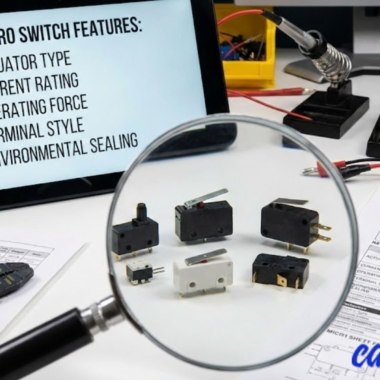
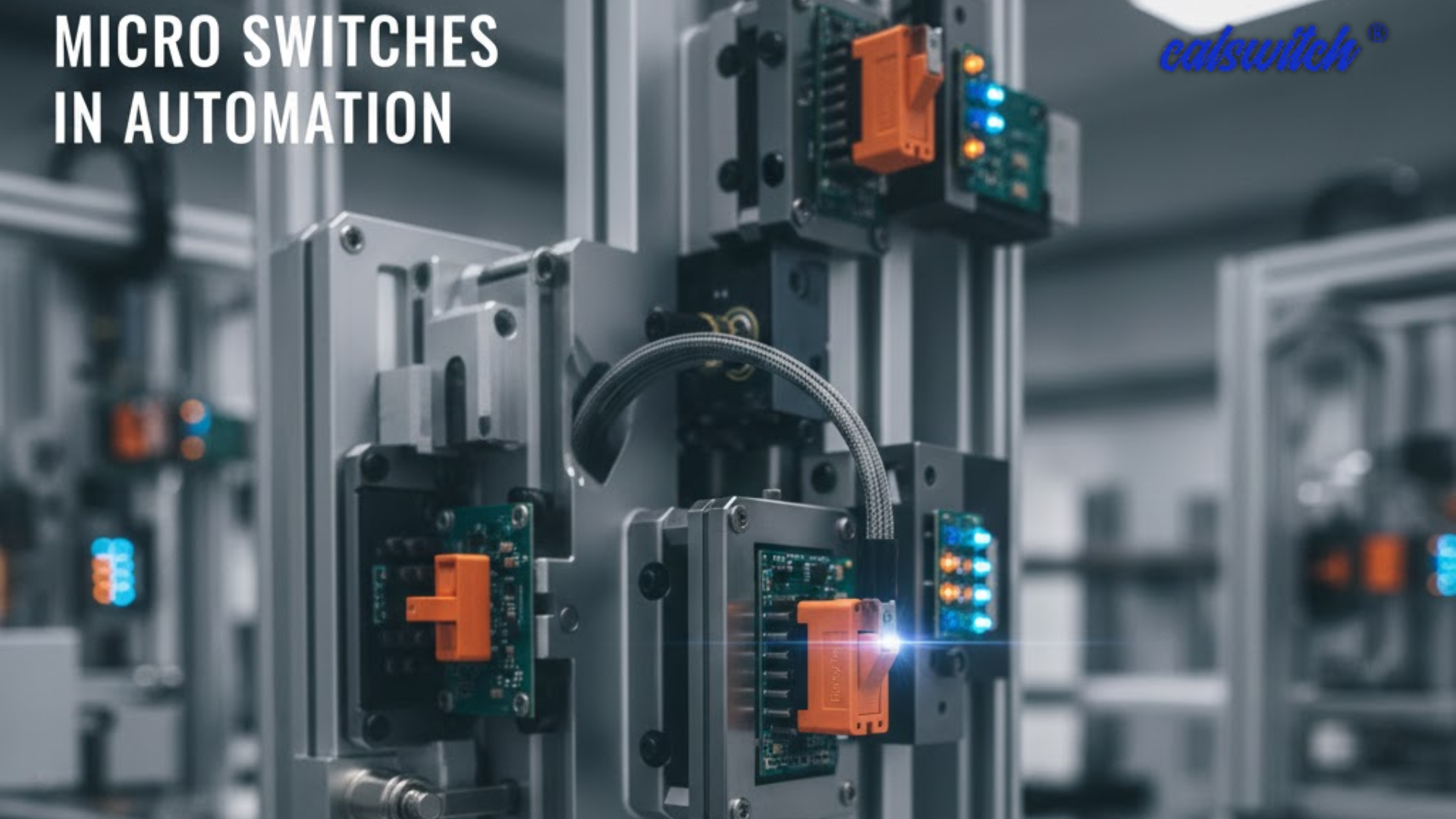
Summary: Micro switches play a critical role in industrial automation by enabling precise control and dependable signal switching. This guide explains how these compact components operate, where they fit into automated systems, and why selecting the right configuration matters. It also explores the relevance of Honeywell micro switch solutions and the role of positive opening switch mechanisms in safety driven environments.
Industrial automation relies on accuracy, repeatability, and safety. Micro switches support these requirements by translating physical movement into electrical signals that machines interpret instantly. Engineers value these switches for consistent actuation and mechanical reliability. Within advanced automation setups, Honeywell micro switch products often pair with a positive opening switch design to support dependable operation in demanding industrial conditions.
Understanding Micro Switches in Industrial Automation
Micro switches are activated by a snap action mechanism, which alters conductive contacts when an actuator hits a specific point. This high speed allows reducing the bouncing of contacts and provides a clear signal transmission. This behavior is used by the automation systems to identify position, limit travel, or invoke control logic.
The positive opening switch design improves the reliability through a mechanical separation of contacts when the actuator is actuated. The structure is useful in safety-oriented automation where the controllers must have complete assurance of a state change.
Core Components That Drive Micro Switch Functionality
All micro switches are made up of actuators, a spring system, electrical contacts, and a housing. The actuator works with a machine element. After the force reaches a certain point, contacts between one state and the other are flicked by the inner spring.
Micro switches are built into automation lines by engineers to keep track of the conveyor status, robotic arms, and mechanical interlocks. A positive opening switch is used in such applications to make sure that the contacts will be separated even under fault conditions to strengthen system integrity.
How Micro Switches Translate Motion into Control Signals
The automation systems rely on correct feedback. Micro switches translate the mechanical movement into binary electrical pulses, which are immediately interpreted by programmable logic controllers. This conversion makes machines react to the real-world condition in real time.
The manufacturers usually indicate Honeywell micro switch units in carrying out work that demands high repeatability. The switches are able to sustain the actuation point of the switch through many millions of cycles, enabling the switches to run continuously without calibration drift.
Role of Micro Switches in Safety and Compliance
There must be certainty with safety circuits. Forced contact separation Micro switches are usable in emergency stops, guard monitoring, and access control. The positive opening switch layout will ensure the reversion to disengagement of the contacts when actuated despite internal spring failures.
This kind of mechanical certainty is often accepted as a basis of functional safety at automation standards. Such switches are incorporated into the systems of engineers in which there is a conjunction of human interaction and automated motion.
Applications Across Industrial Automation Systems
Micro switches assist in a great number of automation activities. They are utilized to detect position by packaging equipment. They are used in material handling systems to identify the presence of loads. They are used as input devices that are reliable in control panels.
Within most of such environments, the engineers choose Honeywell micro switch products because of their ability to operate consistently at both temperature changes and electrical loads. These features minimize downtime and make the maintenance planning easier.
Environmental Considerations in Automation Installations
Responsiveness of the system is determined by actuation precision. Micro switches operate when set to predefined force levels, and therefore the results are repeatable. This predictability gives designers of automation the liberty to fine-tune the sequences without considering signal variation.
A positive opening switch is used to increase this accuracy by removing the uncertainty in making contact separation. What comes out is a distinct, unmistakable indicator that is congruent with automation logic demands.
Dust, moisture, vibration, and changes in temperature are present in industrial settings. Micro switch housings inhibit these stressors on internal mechanisms. There is no loss of electrical performance in sealed designs even in harsh zones of operation.
In such situations, automation engineers frequently use Honeywell micro switch assemblies due to the fact that material choice and build will contribute to long-term durability even though it does not require frequent replacement.
Integration with Control Panels and PLC Systems
The clean inputs rely on control panels. Micro switches are hardwired to programmable logic controllers, which feed real-time status information. These are the signals that conduct decision-making in automated processes.
A positive opening switch form is better at signal integrity, as it makes the contact state reflect physical reality. This is to minimize false positives and improve the level of system confidence.
Maintenance and Lifecycle Benefits
Micro switches have a high life expectancy because of reduced contact consumption. Snap action behavior enhances less arcing, and strong materials withstand fatigue. Teams that carry out maintenance enjoy extended maintenance cycles and the ease of diagnostics.
Identification of Honeywell micro switch models facilitates lifecycle planning by using the uniformity of product specifications and availability of the products in the industrial sectors.
Optimizing Micro Switch Placement for Maximum Efficiency
The right installation of micro switches in the automation systems is important in providing accurate operation. To ensure that the actuators will perform well, engineers will be required to assess their alignment, force limits, and contact with the environment. The use of a positive opening switch setup is used to ensure that there is uniform contact separation even when the mechanical stress is strong. This lowers downtime, and the production lines do not stop.
Selecting the Right Switch for Specific Industrial Applications
Not all micro switches are created equal. Some applications need enhanced resilience, increased life span, or actuation forces. This can be exemplified by heavy-duty conveyors requiring switches that have heavy internal mechanisms and compact robotics using miniature designs. Not only do Honeywell micro switch units offer a flexible selection to find the right one to match the needs of a wide range of industries, but they also provide a stable operation at various voltages and temperature ranges. Selecting the right switch enhances better reliability of the systems and lowers the cost of maintenance in the long run.
Testing and Validation of Micro Switches in Automation
Before deployment, micro switches should undergo rigorous testing to validate performance under actual operational conditions. Engineers will often model the actuator motion, electrical load, and environmental load to make sure that the switch will act as desired. A positive opening switch is also used so that contacts during simulated faults are fully separated to give the right signals. This step confirms that both safety and operational requirements are fully met, supporting long-term automation efficiency.
Conclusion
Micro switches form a foundational element in industrial automation systems by delivering precise, reliable control signals. Their snap action design, combined with safety-oriented features, supports both performance and compliance. Selecting proven solutions such as Honeywell micro switch products enables engineers to build dependable systems with reduced risk. For automation professionals seeking reliable switching components, CalSwitch offers expert guidance and trusted product sourcing.
Explore CalSwitch or contact sales@calswitch.com to find industrial grade micro switches designed for dependable automation performance.
Frequently Asked Questions
1. What makes micro switches suitable for industrial automation?
Micro switches provide precise actuation points and fast signal response, supporting consistent automation performance.
2. How does a positive opening switch improve safety?
A positive opening switch ensures mechanical contact separation, delivering reliable status feedback in safety circuits.
3. Where do micro switches typically operate in automation systems?
They are used in conveyors, robotic assemblies, control panels, and safety interlocks.
4. Do micro switches require frequent maintenance?
Micro switches are characterized by long service life, and less maintenance is required where the switches are specified properly.